The Davenport Brothers
Ira Erastus Davenport (1839–1911) and William Henry Davenport (1841–1877)
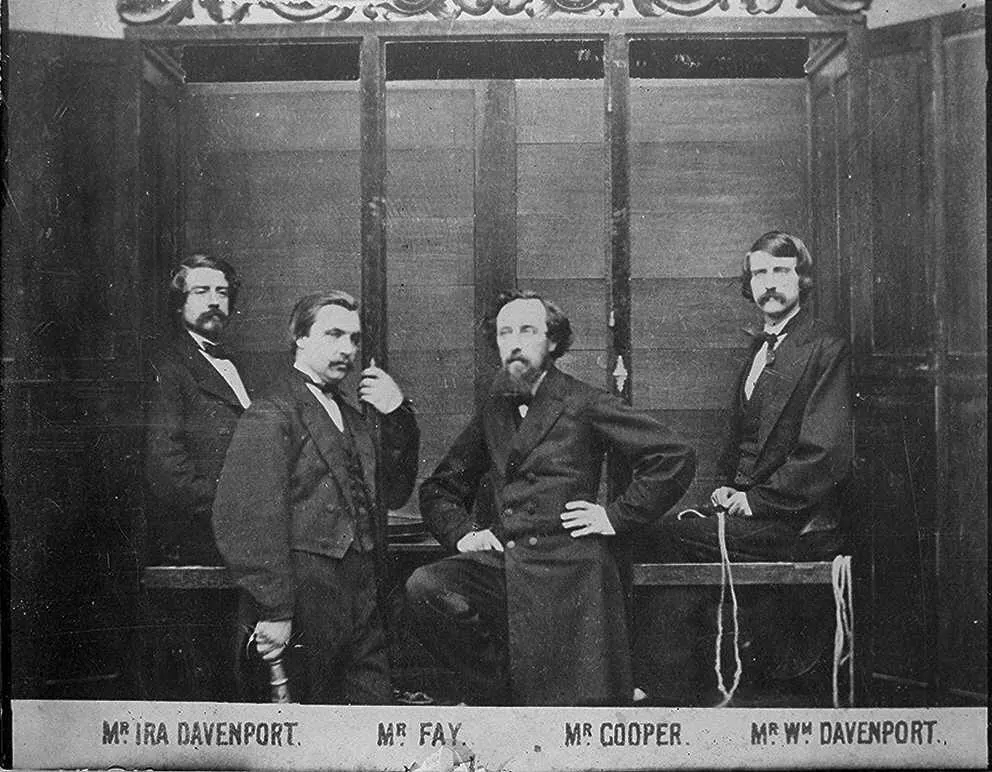

The brothers who presented their work as the doing of spirits — exposed by Maskelyne, and an apprenticeship for Kellar.
- Born
- 1839
- Died
- 1911
- Country / base
- United States
- Genres
- Stage Magic ・Illusion
This archive already refers to them twice — as the men Maskelyne exposed, and as the company where Kellar served his apprenticeship. The history of magic in the later nineteenth century splits in two directions through these brothers.
Key achievements
- Born in Buffalo, New York — Ira Erastus on 17 September 1839, William Henry on 1 February 1841.
- Introduced the "cabinet" to the mediumistic repertoire, presenting phenomena such as instruments that played by themselves.
- In June 1865 their methods were demonstrated on stage in Cheltenham by John Nevil Maskelyne and George Alfred Cooke.
- In 1869 the young Harry Kellar joined their company; the future dean of American magicians served his apprenticeship there.
Brothers from Buffalo
Ira Erastus Davenport was born on 17 September 1839 and William Henry Davenport on 1 February 1841, both in Buffalo, New York.
What they brought to spiritualism was the cabinet — an enclosure the performers entered, from which phenomena issued, including instruments that played by themselves. Bound hand and foot, they went into the cabinet; the doors closed; the sounds began.
The format became the template for mediumistic performance thereafter.
What they did not say
Here is the decisive fork.
A magician presents work as a performance. Impossible things happen, and they happen because of the performer’s skill, not through supernatural agency. The astonishment is delivered on top of that shared understanding.
The Davenport Brothers did not say that. The phenomena were presented as the work of spirits.
The same events change character entirely on that single point. Presented as performance, it is entertainment; presented as evidence that spirits exist, it bears on the judgement and the money of anyone who believes it. In the nineteenth-century spiritualist boom, considerable sums changed hands and believers were hurt.
Cheltenham, June 1865
In June 1865, in Cheltenham, a young John Nevil Maskelyne was in the audience.
Then an accident occurred. A small square of drapery fell from one of the hall’s high windows, and for a moment the unrestrained figure of Ira was visible, throwing instruments by hand from inside the cabinet.
Maskelyne understood the arrangement, and together with the cabinet-maker George Alfred Cooke he demonstrated the method publicly on stage.
That episode set Maskelyne on the path to becoming a professional conjurer. The foundation of British magic begins with this exposure.
1869, Kellar joins
The story then takes an entirely different turn.
The same company that had been exposed in England in 1865 was joined, in America in 1869, by the young Harry Kellar. Billed as The Davenport Brothers and Fay, it is where Kellar learned the touring trade.
The man who would later be called the dean of American magicians, and who would hand his billing to Howard Thurston, started here.
The same brothers were an adversary to one performer and a training ground for another. Both major streams of later nineteenth-century magic — Maskelyne’s in Britain and Kellar’s in America — run through them.
Afterwards
William Henry died in 1877 and Ira Erastus in 1911.
They are in this archive not for their standing as performers. They are here because they illuminate, from the opposite side, what it means that magic declares itself to be a performance.
The tradition of catching counterfeit impossibilities, running from Maskelyne through Houdini to Penn & Teller, began as an objection to these two men.
Notable works
- The cabinet séance, which set the template for mediumistic performance
Chronology
Only years that could be verified are listed.
- 1839 Ira Erastus Davenport is born in Buffalo, New York, on 17 September
- 1841 William Henry Davenport is born on 1 February
- 1865 In June, their methods are demonstrated by Maskelyne and Cooke in Cheltenham
- 1869 Harry Kellar joins the company
- 1877 William Henry dies
- 1911 Ira Erastus dies
What to watch for
- Consider the difference between a phenomenon explained as "the spirits did it" and one explained as "I did it".
- Magic is defined by the performer declaring it to be a performance. This is a case for thinking about what happens when that declaration is withheld.
- A good family conversation — being believed and being astonishing are not the same thing.
We never explain the secrets
You will not find any explanation of how a trick works on this site. Being astonished without knowing is the whole value of the art.
Official links
Sources
The dates and achievements on this page were verified against the following references.
- Davenport brothers Wikipedia(英語版)
- Davenport Brothers, Ira Erastus (1839–1911) and William Henry (1841–1877) Encyclopedia.com
- Ira Erastus Davenport Magicpedia(Genii Magazine)