John Nevil Maskelyne
Master of the Egyptian Hall
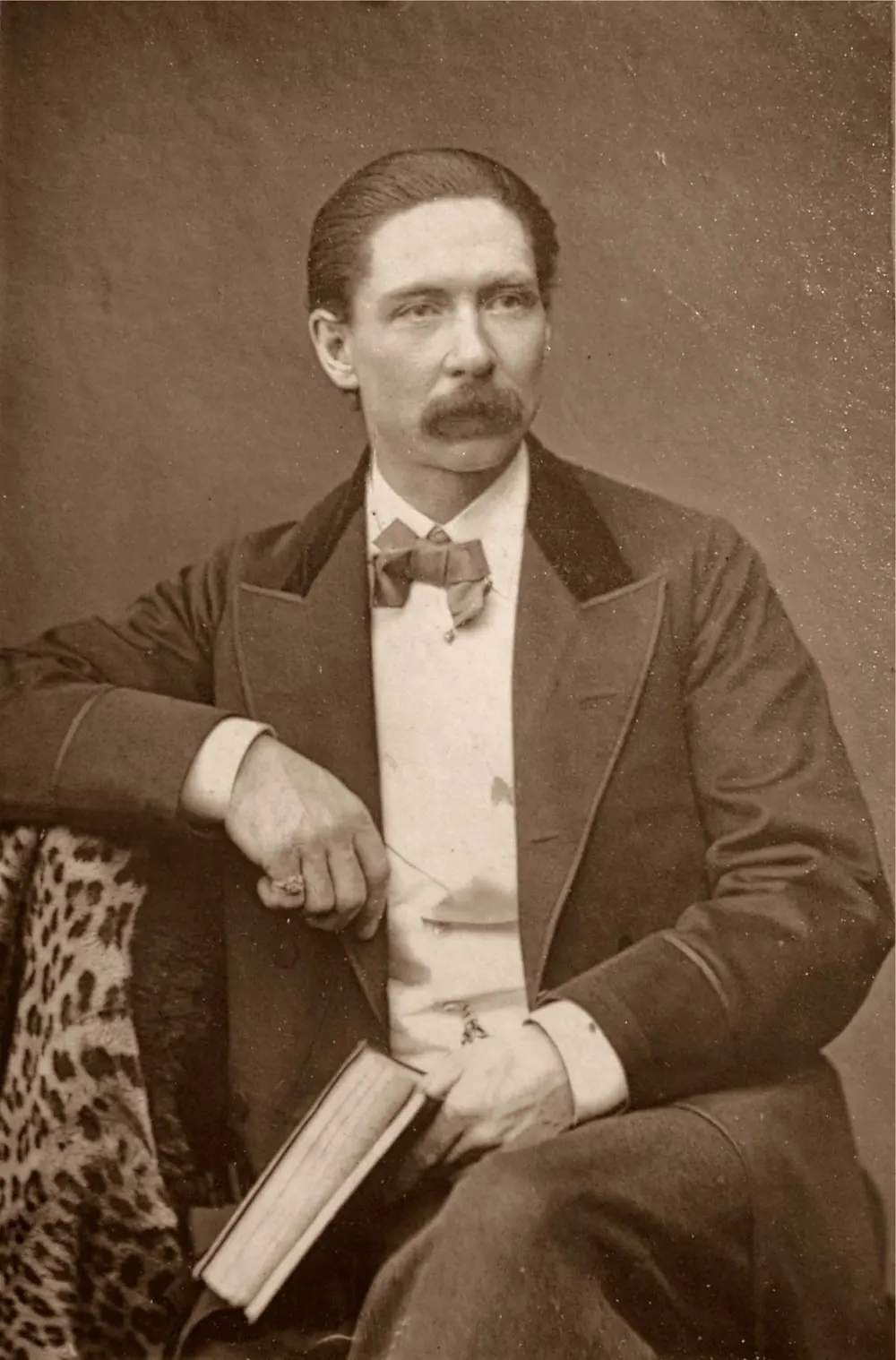

The showman who gave London a permanent home for magic and laid the foundation of British conjuring.
- Born
- 1839-12-22
- Died
- 1917-05-18
- Country / base
- United Kingdom
- Genres
- Stage Magic ・Illusion
Someone had to turn magic from an occasional touring novelty into something you could go and see any evening you liked. In London, that man was Maskelyne. What he built was not an act but a machine for delivering wonder night after night — and he used it to fight lies.
Key achievements
- Established a long-running permanent magic show at London's Egyptian Hall.
- Publicly examined and challenged spiritualist claims from the stage, beginning a tradition of magicians confronting supernatural claims.
- The Maskelyne family led British magic across three generations.
A partnership with a cabinet-maker
Maskelyne was born in 1839 in Cheltenham, Gloucestershire.
His career began not with a performance but with an exposure. In June 1865, in his home town, he demonstrated on stage the methods of the Davenport Brothers, spiritualists then drawing large audiences. Phenomena presented as the work of spirits were shown to be nothing of the kind.
That episode led him to join forces with George Alfred Cooke, a cabinet-maker, and turn professional. His life as a conjurer started on the debunking side of the ledger.
Thirty-one years at the Egyptian Hall
In 1873, after a short season at St James’s Hall in Piccadilly, the pair took a lease on the Small Hall at the Egyptian Hall nearby. They soon moved into the Large Hall and stayed there until the building was demolished in 1904.
Thirty-one years.
This was an innovation in showmanship rather than in conjuring, but its effects ran deep. Nineteenth-century magicians were travellers by default — a few nights in one town, then on to the next. A fixed home meant material could be rehearsed, revised and built upon. Somewhere to stay is also somewhere for an art to grow.
When the building went, they moved their operation to St George’s Hall.
Psycho
Of everything staged at the Egyptian Hall, the piece that drew audiences longest was Psycho.
Psycho was an automaton first presented in January 1875, built with the assistance of John Algernon Clarke. It took the form of a small figure seated cross-legged on a wooden chest, with a rack for thirteen playing cards within reach of its hand, and it played the card game whist.
Psycho was presented more than 4,000 times at the Egyptian Hall. The idea of a machine behaving like a person gripped Victorian audiences, and the fascination is continuous with the one we now bring to robots and artificial intelligence.
A tradition of objecting from the stage
At the same time, spiritualism was spreading across Europe and America. Mediums claimed to contact the dead, producing strange phenomena in darkened rooms. Considerable sums changed hands, and believers were hurt.
Maskelyne went on objecting from the stage. The Davenport affair was only the first instance.
There is a structural reason for this. Being a professional manufacturer of the impossible is precisely what makes a person alert to counterfeit impossibilities. A magician knows, as a matter of trade, the conditions under which people misread what is in front of them, and is therefore well placed to catch anyone exploiting that.
The stance began with Maskelyne, was taken up by Houdini in his later years, and continues today in the work of Penn & Teller. Magicians have held the role for more than 150 years.
Inventions away from the stage
Maskelyne’s inventiveness was not confined to stage machinery.
With his son, John Nevil Maskelyne Jr., he developed a typewriter whose type was inked by a pad and which spaced proportionally. It is thought to have reached the market around 1893.
The other was a lock for the doors of public conveniences, opened by inserting a penny. It is said to be the origin of the English phrase “to spend a penny.”
Working out how a stage illusion should function and working out how a household mechanism should function were evidently the same activity to him.
Three generations
The Maskelyne family remained in British magic for three generations. His son Nevil Maskelyne followed him, and Nevil’s son was Jasper Maskelyne.
The art passed down not through a single gifted performer but through a family and a building. What Maskelyne really left behind may have been neither a repertoire nor an automaton, but a vessel in which magic could keep going.
He died in Marylebone, London, in 1917.
Notable works
- "Psycho" — an automaton that played the card game whist, presented over 4,000 times at the Egyptian Hall
- The permanent season at the Egyptian Hall (1873–1904)
- The pay-toilet lock, opened by a penny coin — said to be the origin of the phrase "to spend a penny"
Chronology
Only years that could be verified are listed.
- 1839 Born in Cheltenham, Gloucestershire, England
- 1865 In June, exposes the methods of the spiritualist Davenport Brothers on stage in Cheltenham, and turns professional with the cabinet-maker George Alfred Cooke
- 1873 After a season at St James's Hall, Piccadilly, takes a lease at the Egyptian Hall
- 1875 In January, presents the automaton "Psycho" for the first time at the Egyptian Hall
- 1893 A typewriter developed with his son reaches the market
- 1904 Moves to St George's Hall following the demolition of the Egyptian Hall
- 1917 Dies in Marylebone, London
What to watch for
- Consider how hard it is to perform something every night rather than once. Keeping the same astonishment fresh across thousands of shows is its own craft.
- Watch for the moments when a performer sets out to demonstrate something. Maskelyne made that stance entertaining.
- A good family conversation — "What is the difference between real mystery and a well-made deception?"
- Machines pretending to be people drew crowds in the nineteenth century too. It reads better if you treat it as continuous with our curiosity about robots today.
We never explain the secrets
You will not find any explanation of how a trick works on this site. Being astonished without knowing is the whole value of the art.
Official links
Sources
The dates and achievements on this page were verified against the following references.
- John Nevil Maskelyne | Illusionist, Mentalist & Escapologist Encyclopædia Britannica
- John Nevil Maskelyne Wikipedia(英語版)
- Psycho (automaton) Wikipedia(英語版)
- John Nevil Maskelyne Grace's Guide to British Industrial History
- Maskelyne and Cooke — Egyptian Hall, London 1873–1904(全文) Internet Archive