Harry Houdini
born Erik Weisz
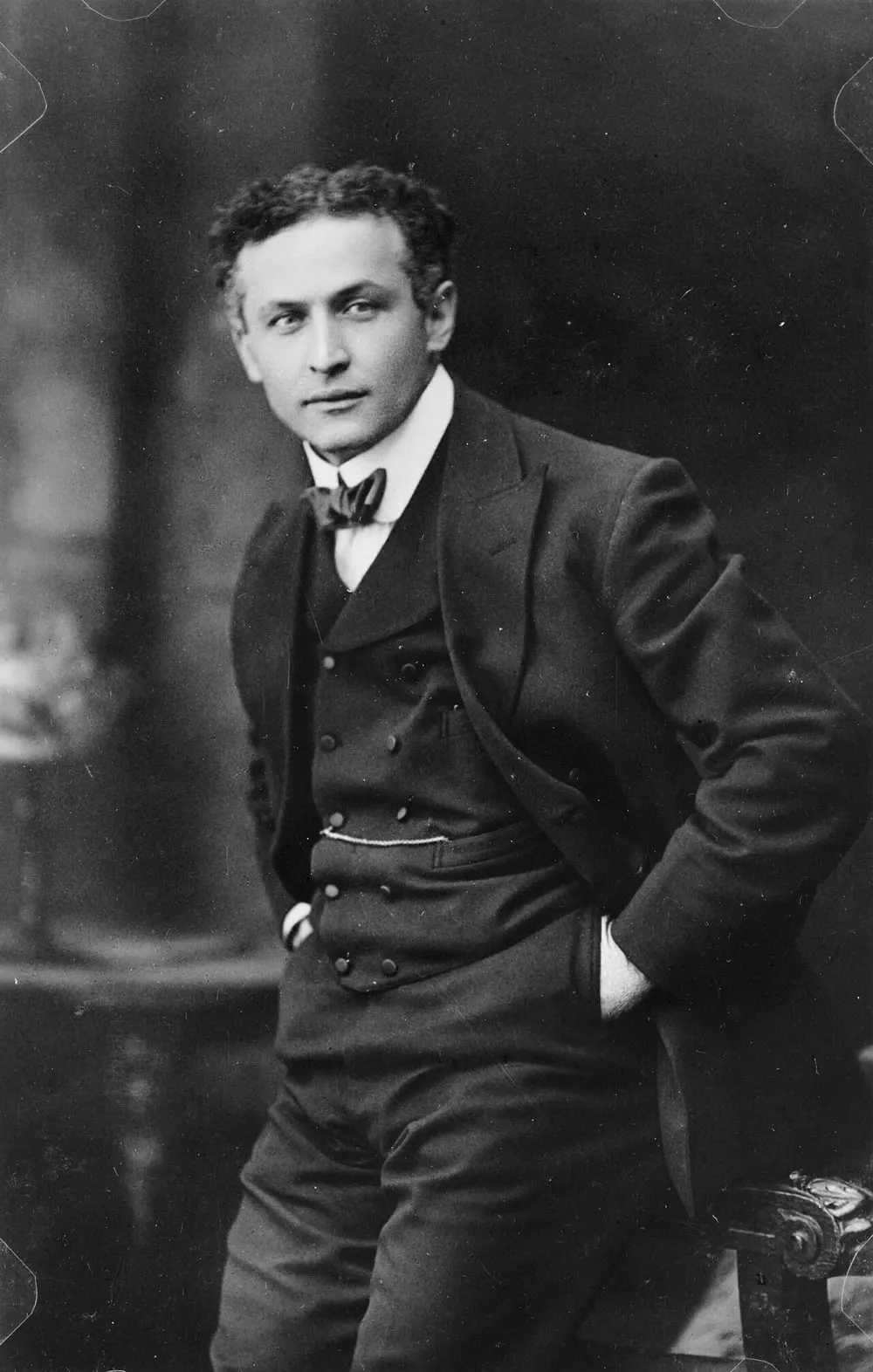

The Handcuff King — a century on, still the single most recognised name in magic.
- Born
- 1874-03-24
- Died
- 1926-10-31
- Country / base
- Born in Hungary, active in the U.S.
- Era
- The Golden Age
- Genres
- Escapology ・Stage Magic
Ask most people to name a magician and this is the name you get. A century after his death, Houdini survives as a common noun as much as a person. Follow the life closely, though, and the volume of work far exceeds the single word "escape".
Reference footage (unofficial)
The following are not official channels but uploads by third parties. We link to them rather than embedding them, and will take a link down promptly at a rights holder's request.
- Footage from 1908 Channel: SICT México
- Compiled archive footage Channel: David Folender
Key achievements
- Born Erik Weisz in Budapest and emigrated to the United States as a child.
- Built worldwide fame on escapes from handcuffs and restraints.
- Devoted his later years to investigating and exposing fraudulent mediums.
- Died on 31 October 1926; the Halloween anniversary is still marked by the magic community.
Budapest to Appleton
He was born Erik Weisz in Budapest on 24 March 1874. In 1878, when he was four, the family emigrated to the United States and settled in Appleton, Wisconsin.
One detail shows what that town meant to him. Houdini maintained for the rest of his life that he had been born in Appleton, on 6 April. He chose to present himself as an American rather than as an immigrant. Before he ever picked a stage name, he was a man who wrote his own story.
That stage name is said to have been chosen in tribute to the great French predecessor Robert-Houdin. The name alone tells you which lineage he intended to claim.
From a brother act to a marriage
In 1893 he was appearing at Coney Island with his brother Dash — Theodore — as “The Brothers Houdini.” There he met a fellow performer, Wilhelmina Beatrice Rahner, known as Bess.
They married the following year, and Bess replaced Dash in the act, which became “The Houdinis.”
The signature piece of that partnership was Metamorphosis, in which the two exchanged places inside a locked trunk in an instant. Houdini is remembered almost entirely for escapes, but the origin of his career is a two-person act with his wife.
1899, and the decision to narrow
The turn came in 1899, when he met the manager Martin Beck in St Paul, Minnesota.
Beck was struck by his handcuff work and advised him to concentrate on escapes, then booked him onto the Orpheum vaudeville circuit.
That proved decisive. From a performer who did a bit of everything to one who did a single thing. In 1900 he left for Europe, arriving in London to find that the bookings he had been promised had not in fact been secured. He made his name there regardless, and returned a different order of performer.
The invention of the escape
The form has a particular power.
First the audience verifies that he is genuinely confined. Then time simply passes. The interval in which nothing happens is itself the tension. Then he is free. No other kind of act is built out of duration in quite this way.
In 1908 he introduced the Milk Can, advertised with the line “Failure Means a Drowning Death.” In 1912 came the Chinese Water Torture Cell, which became his best-known piece — suspended upside down and shackled inside a cabinet filled with water.
He pushed the conditions to the point where audiences genuinely wondered whether it could be done. The tension came from the design rather than from the presentation.
Film as the next stage
Houdini’s work was not confined to the stage.
He made a short film in Paris in 1909, and his first substantial move into narrative cinema was The Master Mystery, a fifteen-part serial that began release in November 1918. When a new medium appeared, he went to it at once — a performer who set about preserving himself on film before television existed.
The work of his last years
Late in life, Houdini devoted himself to investigating and exposing fraudulent mediums.
He publicly offered $10,000 to any medium who could produce phenomena he was unable to explain, and joined several investigating committees, among them one convened by Scientific American.
The confrontation that began in 1924 with Mina Crandon, known publicly as Margery, became the longest and most publicised of all his medium investigations.
Being a professional manufacturer of the impossible is precisely what makes a person able to spot a counterfeit one. The stance began with Maskelyne, passed through Houdini, and continues today in the work of Penn & Teller.
31 October 1926
In October of that year, during a stay in Montreal, a young man struck him in the abdomen in his dressing room. Houdini is said to have invited the blows as a test of his own famed physical strength, and the blows are held to have aggravated a case of appendicitis.
On 31 October 1926 he died in Detroit of peritonitis following a ruptured appendix. He was 52.
Because the anniversary falls on Halloween, the date is still marked by the magic community. Few performers leave a name behind; fewer leave a date.
Notable works
- "Metamorphosis" — the signature piece of the double act with his wife Bess
- The Milk Can escape (1908)
- The Chinese Water Torture Cell (1912)
- The film serial The Master Mystery (1918) and other silent-film work
Chronology
Only years that could be verified are listed.
- 1874 Born Erik Weisz in Budapest on 24 March
- 1878 The family emigrates to the United States and settles in Appleton, Wisconsin
- 1893 Meets Bess Rahner at Coney Island while working as "The Brothers Houdini" with his brother Dash
- 1894 Marries Bess; the act becomes "The Houdinis" with "Metamorphosis" as its signature
- 1899 Meets the manager Martin Beck, who advises him to concentrate on escapes
- 1900 Departs on a European tour
- 1908 Introduces the Milk Can escape
- 1912 Introduces the Chinese Water Torture Cell
- 1918 The film serial The Master Mystery begins release in November
- 1924 His long, public confrontation with the medium Mina Crandon, known as "Margery", begins
- 1926 Dies in Detroit on 31 October
What to watch for
- In an escape, the real subject is time. It is a rare kind of act where feeling long counts as succeeding.
- Watch how the performer makes a promise to the room. There is a bluntness in announcing what will be attempted.
- Worth telling children — making you believe it might fail is part of the craft.
- Notice the force of someone who pursued one thing exhaustively. Narrow and deep is a way of working.
We never explain the secrets
You will not find any explanation of how a trick works on this site. Being astonished without knowing is the whole value of the art.
Official links
Sources
The dates and achievements on this page were verified against the following references.
- Harry Houdini (1874–1926) | American Experience PBS(米国公共放送)
- Timeline of Houdini's Life | American Experience PBS(米国公共放送)
- Harry Houdini Wikipedia(英語版)
- Harry Houdini and his unbreakable chain to Appleton Wisconsin Life(ウィスコンシン公共放送)