Jean-Eugène Robert-Houdin
The Father of Modern Magic
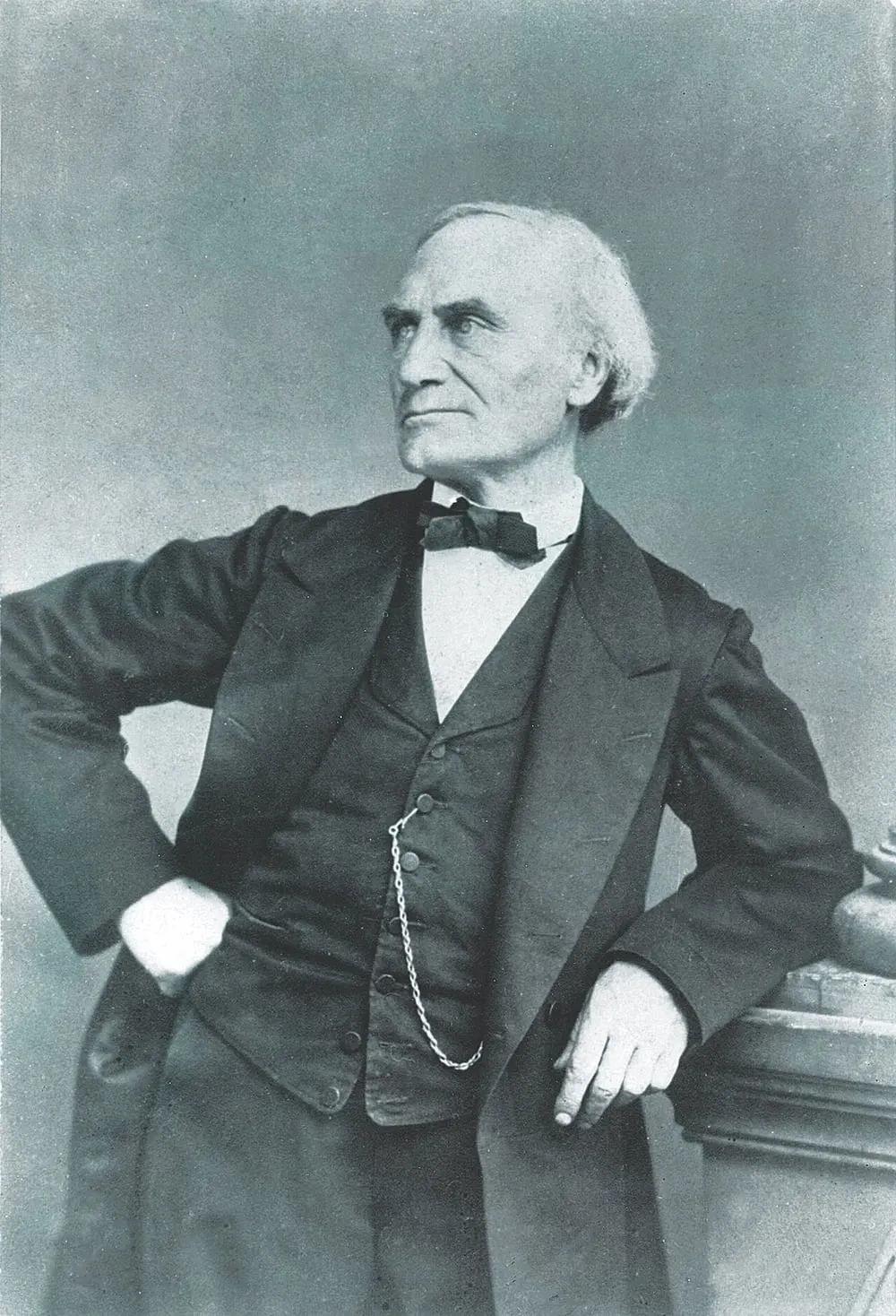

The father of modern magic — the first to abandon wizard robes and perform in evening dress.
- Born
- 1805-12-07
- Died
- 1871-06-13
- Country / base
- France
- Genres
- Stage Magic ・Manipulation
The image most of us carry of a magician was, in a real sense, invented by this man. Not a wizard in a pointed hat, but a performer standing on a stage in ordinary evening dress. What he changed was not a repertoire but the definition of the job itself.
Key achievements
- A trained clockmaker who brought precision mechanics to the stage and opened his own theatre in Paris.
- Abandoned the oriental and wizardly costumes of his day, performing instead in the same evening dress as his audience.
- Recast conjuring from fairground spectacle to theatrical art, defining what a magician would look like ever after.
- Harry Houdini is said to have taken his stage name in tribute to him.
Born into a clockmaker’s house
Robert-Houdin was born in 1805 in Blois, a town in central France south-west of Paris that had been an important centre of clockmaking through the sixteenth and seventeenth centuries. His father was a clockmaker, and the son was expected to take up the trade.
He was educated at the University of Orléans, after which he became absorbed by conjuring. By his own account in his memoirs, the spark came from a bookseller’s error — he had ordered a technical treatise on clockmaking and was sent a work on conjuring instead. The anecdote rests on his own telling; no independent contemporary record of it has been confirmed.
What is certain is that he never abandoned the first craft. The precision of gears and springs came with him onto the stage. His best-known pieces, The Marvellous Orange Tree and The Little Pastrycook of the Palais-Royal, were both built around finely made automata.
A theatre of his own in Paris
In 1845 he opened his own theatre at 14 Galerie de Valois in the Palais Royal, Paris, and staged there the show he called Soirées Fantastiques.
One decision he made in that room set the shape of magic afterwards. He gave up the costume.
Conjurers of his day appeared in long oriental robes and star-embroidered gowns, dressed unmistakably as sorcerers. Robert-Houdin stopped doing that, walking out instead in the same evening dress as his audience, onto a stage stripped of ornament.
He moved where the wonder lives
The choice matters. To stop signalling mystery through costume is to place the whole weight of it on the performer’s skill and manner.
When a figure dressed as a wizard does something impossible, the audience retains an escape route — he is playing a part, and parts do impossible things. When a man dressed exactly like you does the same thing, that route closes. What happens can only be attributed to the person standing there.
That principle became the operating design of magic for the next hundred and fifty years. Every magician who takes the stage today in a suit or a plain shirt is working in the tradition of those Paris evenings.
Algeria
In 1855 he completed his final tour, left the stage and settled at Saint-Gervais near Blois.
The following year he was called out of retirement. In Algeria, then a French colony, Muslim religious leaders known as marabouts were urging the local population toward revolt, and the French government set out to employ Robert-Houdin’s skills against that situation.
The episode is frequently cited as a case of conjuring pressed into political service. It is also one that cannot honestly be told apart from the colonial context in which it happened.
The work of writing it down
The other work of his retirement was authorship. Confidences d’un prestidigitateur, published in 1858, is his account of his own life and craft. It was widely read in English as Memoirs of Robert-Houdin, Ambassador, Author, and Conjurer.
Performing is one thing; setting down in words how the work was thought through is another. That habit gave later generations something to examine. Much of what can be said about him with any specificity today exists because he wrote it himself.
He died at Saint-Gervais in 1871.
A name inherited, then challenged
Half a century later, a young escape artist making his name in America is said to have chosen his stage name in tribute to him. That performer was Harry Houdini.
The story does not end there. In 1908 Houdini published The Unmasking of Robert-Houdin, a book disputing much of what had been credited to the older magician. The man who had borrowed the name turned to scrutinising its owner.
Opinion on that book remains divided. What matters more is the underlying fact — that Robert-Houdin has gone on being treated as a subject worth examining. Praise and challenge alike assume that the man is a fixed point in the history.
What remains in his birthplace
In 1981 his descendants transferred a building in Blois and everything in it to the town, on the condition that it be opened to the public. It opened in 1998 as La Maison de la Magie Robert-Houdin and stands opposite the Royal Château de Blois, holding 170 objects that he made or collected.
A clockmaker’s son left behind a house bearing his own name in the town where he was born. As postscripts to a conjuring career go, it has no parallel.
Notable works
- "Soirées Fantastiques" — the show staged at his own Palais Royal theatre
- The Marvellous Orange Tree — an automaton piece
- The Little Pastrycook of the Palais-Royal — an automaton piece
- Confidences d'un prestidigitateur (1858) — his memoir, translated as Memoirs of Robert-Houdin
Chronology
Only years that could be verified are listed.
- 1805 Born in Blois, central France, to a clockmaker father
- 1845 Opens his own theatre at 14 Galerie de Valois, Palais Royal, Paris
- 1855 Completes his final tour, retires from the stage and settles at Saint-Gervais near Blois
- 1856 Travels to Algeria at the request of the French government
- 1858 Publishes his memoir Confidences d'un prestidigitateur
- 1871 Dies at Saint-Gervais
- 1998 La Maison de la Magie Robert-Houdin opens in his birthplace, Blois
What to watch for
- Notice what the performer is wearing. The idea of producing wonder while dressed like everyone else in the room starts here.
- Watch the pauses rather than the props. He speaks, meets your eye, waits a beat. That rhythm is his real legacy.
- A good question for children — "He isn't dressed as a wizard at all. So why does it still look like magic?"
- Precision engineering and the stage are closer than they look. Picture the same exactness that sets a gear train being applied to timing an evening.
We never explain the secrets
You will not find any explanation of how a trick works on this site. Being astonished without knowing is the whole value of the art.
Official links
Sources
The dates and achievements on this page were verified against the following references.
- Jean-Eugène Robert-Houdin | Illusionist, Inventor, Showman Encyclopædia Britannica
- Jean-Eugène Robert-Houdin Wikipedia(英語版)
- Robert-Houdin Magicpedia(Genii Magazine)
- Memoirs of Robert-Houdin, Ambassador, Author, and Conjurer(自伝の英訳全文) Project Gutenberg
- House of magic(ロベール゠ウーダンの魔法の館) ブロワ市公式サイト