Alexander Herrmann
"Herrmann the Great"
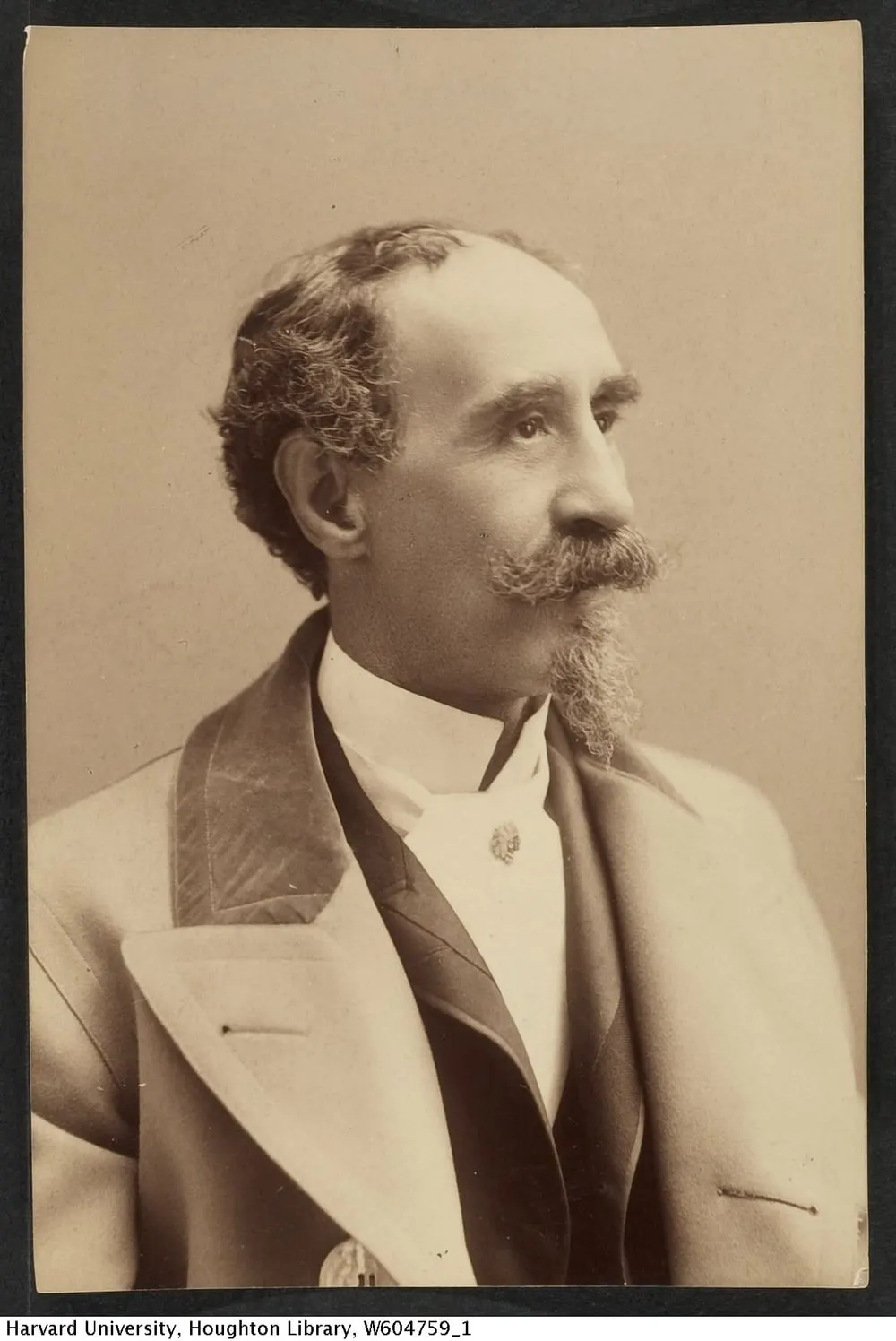

"Herrmann the Great" — for a generation, the very image of what a magician looked like.
- Born
- 1844-02-10
- Died
- 1896-12-17
- Country / base
- Born in France, active in the U.S.
- Genres
- Stage Magic ・Illusion
Ask a child to draw a magician and you will usually get the same figure — thin moustache, tall hat, dark cape. There was a real person behind that picture, and his name was Alexander Herrmann. What he left behind was not an act but the appearance of a profession.
Key achievements
- Born in Paris and followed his brother Carl to America, where he became hugely popular on tour.
- His pointed moustache and formal silhouette became the visual archetype of the stage magician.
- Performed impromptu off stage as well, turning the magician into a public celebrity.
On stage at eight
Herrmann was born in Paris in 1844 into a family of conjurers. His much older brother Carl — Compars Herrmann — was already internationally known.
For the younger brother, Carl was both model and target. Alexander joined his show at the age of eight and toured the world alongside him. The stage was his living environment before he was old enough to choose it.
In time he separated from his brother and led his own company, working chiefly in America. In July 1876 he became a naturalised American citizen in Boston.
“Herrmann the Great”
For the latter half of the nineteenth century in America, he was simply the face of the profession. The name “Herrmann the Great” stuck, and the business was hugely successful.
His way of living records the scale of that success plainly. He travelled by private railway car and owned several houses and yachts. There was, demonstrably, a period in which a magician could live as a wealthy man.
When an appearance becomes a convention
Herrmann’s distinguishing features were a pointed moustache and immaculate formal dress. As that image circulated, it hardened into a social convention — this is what a magician looks like.
This is his largest legacy. Repertoires turn over with the years, but the image of a profession persists. The magicians drawn in cartoons and in animation can be traced back to this single performer more than a century ago.
Still performing off stage
Herrmann astonished people away from the theatre as well, staging impromptu moments in the street or at dinner that became talking points and fed his reputation. He drew no line between on stage and off.
This was not merely temperament; it was a method of business. Newspapers were the only mass medium of the age. An incident in the street that made the paper was advertising in itself. His approach lifted the magician from a craftsman who appears in a theatre to a public celebrity.
Adelaide
In 1875 he met Adelaide Scarcez and married her soon after. She had been born in London in 1853 to Belgian parents.
The two performed together thereafter and became one of the most successful acts of the period. What matters here is that she appeared as a performer, not as an assistant.
Aboard a train
In December 1896, Herrmann suffered a heart attack on a train bound for Pennsylvania and died. He was 52. An end that came in transit is arguably fitting for a man who spent his life touring.
He had no children of his own, and his nephew Leon Herrmann had been groomed as successor. After her husband’s death, Adelaide first worked with Leon to carry on the “Herrmann the Great” name, but tensions ran high and the collaboration was short-lived.
Adelaide went on performing alone and came to be known as the Queen of Magic. The Herrmann story did not end with the husband’s death.
What he left
What Alexander Herrmann left behind is not a documented set of routines. It is a single thing — how the job of magician appears to everyone else.
In that sense he is arguably still working. As long as there are children drawing magicians, his contribution is in circulation.
Notable works
- A full-evening touring show across the United States, moved by private railway car
- The stage partnership with his wife Adelaide, who continued performing after his death
Chronology
Only years that could be verified are listed.
- 1844 Born in Paris into a family of conjurers; his much older brother Carl (Compars) was already a celebrated performer
- 1852 Joins his brother's show at the age of eight and tours the world with him
- 1875 Meets Adelaide Scarcez and marries soon after; the two perform together thereafter
- 1876 Becomes a naturalised American citizen in Boston in July
- 1896 Dies of a heart attack in December, aboard a train between engagements
What to watch for
- Think about how much of a magician's effect comes from how they look. Appearance is part of the act.
- Notice the idea that the stage is not the only workplace. Herrmann performed in everyday life too.
- Ask a child what they think a magician looks like — then trace together where that picture came from.
- Skills can be handed down inside a family. It is worth picturing how a craft travels from one person to the next.
We never explain the secrets
You will not find any explanation of how a trick works on this site. Being astonished without knowing is the whole value of the art.
Official links
Sources
The dates and achievements on this page were verified against the following references.
- Alexander Herrmann Wikipedia(英語版)
- Alexander Herrmann Magicpedia(Genii Magazine)
- Compars Herrmann(兄カールについて) Wikipedia(英語版)