Shōkyokusai Tenichi I
松旭斎天一 — Father of Modern Japanese Magic
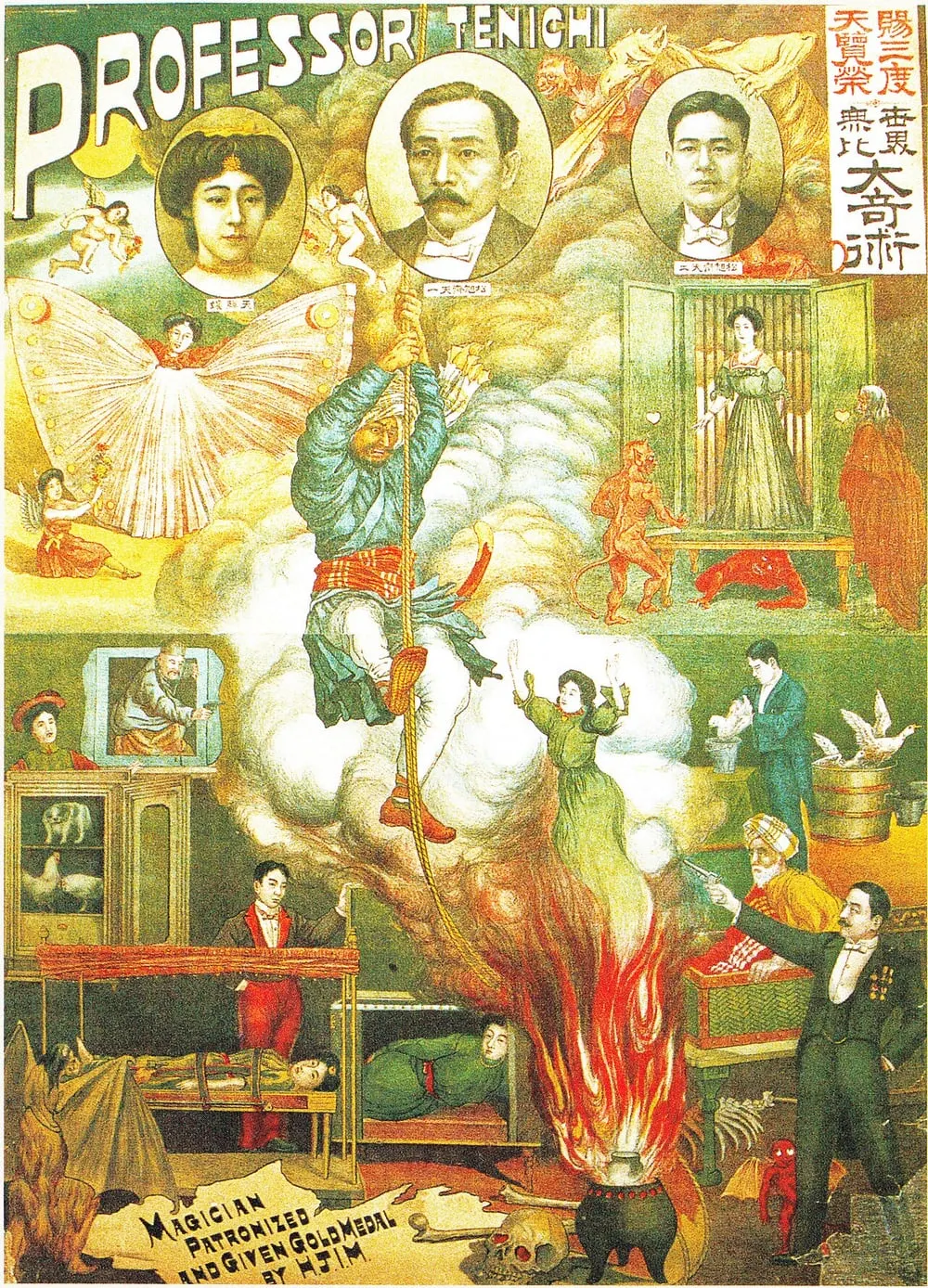

The father of modern Japanese magic, who grafted Western conjuring onto Japan's own tradition.
- Born
- 1853-03-11
- Died
- 1912-06-14
- Country / base
- Japan
- Genres
- Stage Magic ・Illusion
Japan had its own conjuring tradition long before Western magic arrived, known as tezuma. The man who grafted Western stagecraft onto it, and made the result work in a theatre, was Shōkyokusai Tenichi. Trace Japanese magic backwards and a startling number of paths lead to him.
Key achievements
- Born in the castle town of Fukui (present-day Fukui City), under the name Hattori Shōkyoku.
- Acquired Western conjuring in 1878, though sources differ on how.
- Refined the traditional Japanese "water act" (mizugei) into grand theatre and found success in Asakusa.
- Developed street conjuring into modern stage magic and founded the Shōkyokusai school, whose pupils included Tenkatsu.
Born to a samurai family in Fukui
Tenichi was born on 11 March 1853 into a samurai family in the castle town of Fukui. He was the eighth child and eldest son of the Makino family, named Makino Hachinosuke in childhood and later taking the name Hattori Shōkyoku.
His early life was not smooth. He was orphaned at seven and entered a Buddhist temple the following year, at eight — an unlikely starting point for a man who would end up defining an art form.
1878, and the encounter with Western conjuring
In 1878, at twenty-five, he acquired Western conjuring.
One thing should be stated plainly here. Sources differ on how that happened. Some accounts say he travelled to Shanghai to study; others say he learned from an American named Jones. This archive treats only the year as established and declines to assert the route.
Either way, what is certain is that shortly after Japan opened to the outside world, he deliberately went to fetch a foreign technology. The modernisation of Japanese conjuring can reasonably be dated to that year.
Asakusa, the Bunrakuza, 1888
In March 1888 Tenichi staged large-scale work at the Bunrakuza theatre in Asakusa, Tokyo, including the water act and the cannon act, and won his reputation.
The centrepiece was mizugei, the water act.
Mizugei was already old in Japan. What Tenichi did was not import a new routine. He took an existing Japanese form, lifted it out of street-performance scale, and rebuilt it as theatre, with lighting and stage machinery to match.
Neither simply preserving the tradition nor simply importing the West, but using both to make a third thing. That was his method, and it is a pattern that recurs throughout the modernisation of the Japanese performing arts. He was among the first to work it out in conjuring.
The decision at forty-eight
In 1901, at the age of forty-eight, Tenichi made a considerable decision. He disbanded his troupe and went abroad.
A performer with an established reputation at home folded that position and left — at forty-eight, which against the life expectancy of the period was a bold age at which to start again.
He toured close to ten countries, among them the United States, Canada, Britain, France, Italy, the Netherlands and Belgium, and met with substantial success in each. This is a very early instance of a Japanese performer being received on Western stages.
The experience passed to the pupils who travelled with him. Shōkyokusai Tenkatsu, later called the Queen of Magic, met an international audience during these years.
The Shōkyokusai school
Tenichi founded the Shōkyokusai school, whose pupils included Tenji (Tenichi II), Tenkatsu, Ten’yō and Tenshū.
It is the reach of that school that makes him the father of modern Japanese magic. What is notable is that the line did not stop with the Meiji era. Out of Ten’yō’s own pupils came Tenko Hikita I, who held the whole country to its television sets in the postwar decades, and Haruo Shimada, who won international standing with a Japanese-parasol act.
Two of the performers who defined Japanese magic in the second half of the twentieth century were, in other words, two generations down from Tenichi. Calling him the father is not a flourish; it is a statement about the family tree.
1911, and after
Tenichi retired in January 1911 and died on 14 June the following year, at fifty-nine.
Trace the history of Japanese magic and a great many paths lead back to this one man. A boy orphaned in Fukui became the starting point of an entire art in his country. That fact alone earns the name its place.
Notable works
- Mizugei, the water act — a long-standing Japanese form rebuilt at theatre scale
- The cannon act
- The Shōkyokusai school — his pupils included Tenji (Tenichi II), Tenkatsu, Ten'yō and Tenshū
Chronology
Only years that could be verified are listed.
- 1853 Born on 11 March into a samurai family in the castle town of Fukui, the eighth child and eldest son of the Makino family
- 1860 Orphaned at seven; enters a Buddhist temple the following year, aged eight
- 1878 Acquires Western conjuring, though accounts of how differ between sources
- 1888 In March, stages large-scale work including the water act and cannon act at the Bunrakuza in Asakusa, Tokyo, and wins fame
- 1901 At 48, disbands his troupe and tours abroad, visiting close to ten countries including the U.S., Canada, Britain, France, Italy, the Netherlands and Belgium
- 1911 Retires in January
- 1912 Dies on 14 June
What to watch for
- Japanese acts carry a distinctly Japanese physical vocabulary. Watch the fingertips and the carriage of the body.
- Water acts are part of Japan's own tradition. Watch not where the water comes from but how it is presented.
- Worth telling children — people in Japan were being astonished in exactly this way a hundred and fifty years ago.
- Behind every performer stands the teacher who trained them. It is worth picturing how a craft travels from person to person.
We never explain the secrets
You will not find any explanation of how a trick works on this site. Being astonished without knowing is the whole value of the art.
Official links
Sources
The dates and achievements on this page were verified against the following references.
- 松旭斎天一(初代)|近代日本人の肖像 国立国会図書館
- 松旭斎天一 コトバンク(日本大百科全書ほか)
- 松旭斎天一 略歴 福井県(知事記者会見資料)
- 松旭斎 天一 FUKUI MUSEUMS(福井県)
- 松旭斎天一 Wikipedia(日本語版)